An AI candidate profile recruiters can talk to
Designing the candidate profile, the recruiter flows, and the site around them. The profile shipped.
Recruiting still runs on static resumes that take hours to read. I designed a profile you talk to instead of scan, a CV built for an AI-native world, and it shipped as GitRoll’s homepage hero.
- • Specialized in Golang and Python
- • Experienced across AWS, GCP, Kafka, Redis
- • Passionate about backend performance
- • Built pub/sub systems handling 10k+ TPS
01TL;DR
Problem
Recruiters read resumes to guess at people. Candidates write resumes to guess at recruiters. Both sides spend the time and neither gets the answer.
Solution
GitRoll turns the profile into something you ask. The recruiter types a question and the profile answers from the candidate’s own projects and history.
My role
Designed the AI profile, the recruiter and engineer user flows, and the GitRoll website. The AI profile shipped; the agentic recruiter remained a concept.
Impact
A unified system that turns profiles and portfolios into interactive, queryable interfaces instead of static documents.
02Problem space
Past
Resumes, LinkedIn, portfolios. All of it sits there and waits to be read.
Now
People stopped browsing for answers. They ask. A resume is still a document you have to read end to end to find one fact.
Future
GitRoll explores what a future AI-native recruiting experience could look like for both recruiters and candidates.
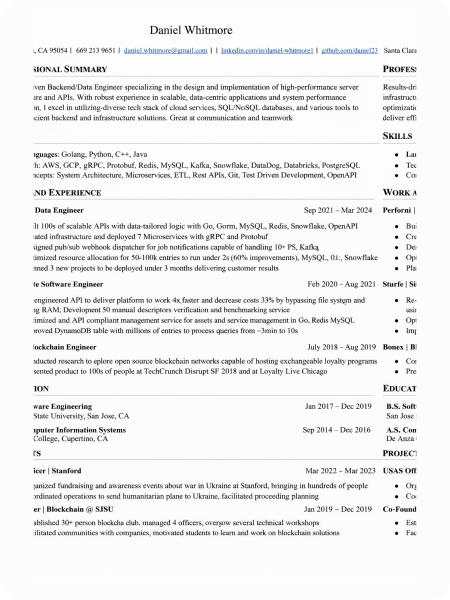 Resume
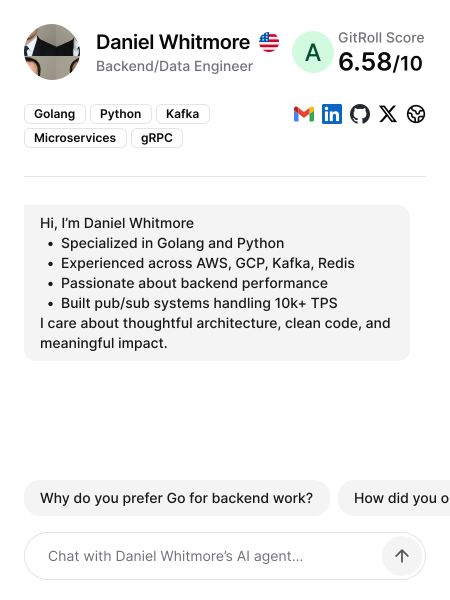 AI profile
Drag or use arrow keys to compare the resume with the AI profile.
03Users
Two sides, one loop. Recruiters looking for a shortlist, engineers looking for a reason to apply.

Recruiters and hiring managers

Candidates and engineers
Their job to be done
Build a high-performing team with minimal friction.
Recruiters want to filter a massive pool of applicants down to three to five hirable finalists, to minimize the hiring manager’s time spent interviewing.
Candidates want to secure a position that meets specific salary, benefit, and tech-stack requirements, while minimizing the cost of the search and the time spent interviewing.
Core insight
In an AI-driven workflow, people want to spend less time searching and managing connections, and more time interpreting meaning.
The design problem stops being a page and starts being an answer.
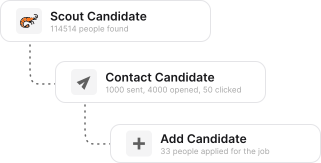
04User flow sketch
05Information architecture
The system moves from raw inputs, through an AI intelligence layer, into conversational outputs.
- LinkedIn (required)
- GitHub, resume (optional)
- Job description
- Structured candidate profile
- Project and evidence memory
- Retrieval with rubric-based reasoning
- Conversational AI profile
- Recruiter workflows
06Product and prototype
AI profile
Goal: enable rapid understanding of a candidate without manual scanning. An interactive AI resume lets employers chat with a candidate avatar, revealing motivations, project context, experience stories, working styles, collaboration preferences, and aspirations.
See it live at gitroll.io.
Multi-source talent pool
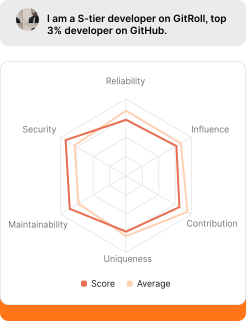
The profile draws signal from across the places people already build a public footprint, so candidates maintain it once and let the system explain it everywhere.
 LinkedIn
 GitHub
 Chatbase
 X / Twitter
 Facebook
 Medium
 Stack Overflow
 YouTube
 Google Scholar
 Reddit
Agentic AI recruiter
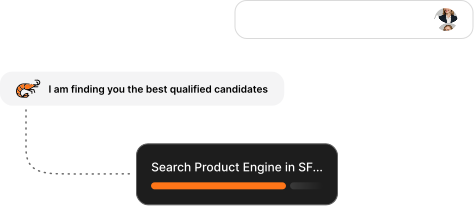
An autonomous recruiter agent converses, defines requirements, searches talent, ranks matches, and schedules interviews, continually learning from hiring outcomes and feedback.
UX flow
Discover, ask, interpret, decide.
Maintain once, share everywhere, let the system explain.
07Outcome
The team approved the AI profile and it moved from concept into the product.
It went live as the main feature on the GitRoll homepage, still there on the hero at gitroll.io.
The company was acquired soon after, and work on the project paused.
Stop recruiting. Start vibe hiring.
08Reflection
Efficiency over novelty
While working on GitRoll, I had to constantly ask myself: is this feature making the AI smarter, or is it actually saving people time? I learned that in recruiting and professional evaluation, intelligence alone isn’t the bottleneck. The real friction is time spent searching, managing connections, and mentally stitching information together. This insight pushed me to prioritize system-level efficiency over feature richness: fewer steps, fewer tools, and faster access to meaningful signals.
Designing AI with restraint
One of the hardest parts of this project was deciding what the AI should not do. It was tempting to automate decisions, generate scores, or make strong recommendations. But I learned that in high-stakes contexts like hiring, over-automation can reduce trust rather than increase it. Designing GitRoll meant intentionally keeping humans in the loop and using AI to support interpretation, not replace judgment.